Introduction
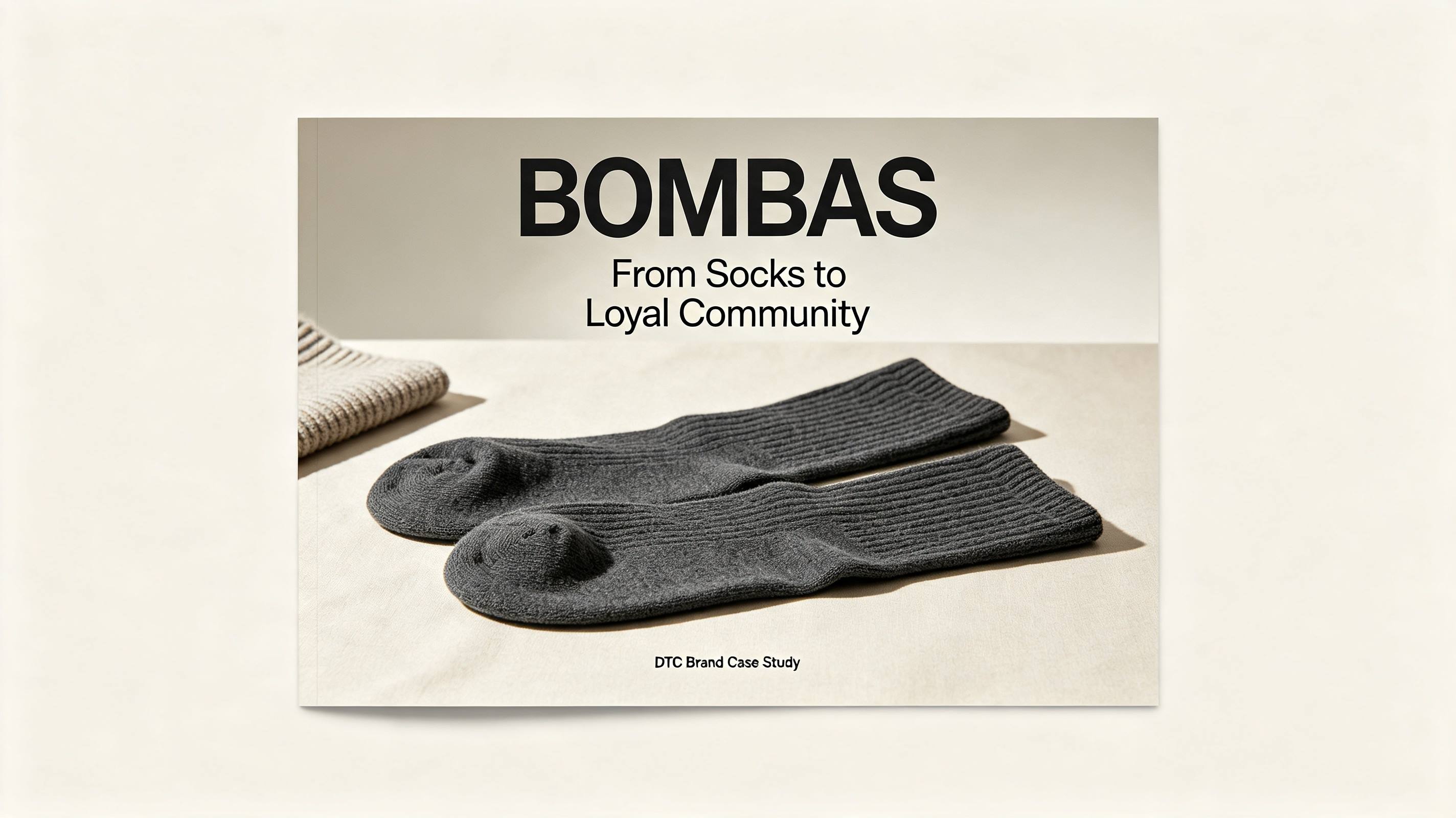
At a time when DTC brands universally face profitability challenges, one brand broke through with nothing more than a pair of socks. That brand is Bombas. As the benchmark DTC sock brand, Bombas built its business without expensive celebrity endorsements and without blanket traditional advertising. Instead, it moved millions of consumers with a concept so simple it was almost rustic: One-for-One, meaning for every pair of socks sold, a pair is donated to a person experiencing homelessness. With cumulative donations exceeding 100 million items based on industry public reports, Bombas stands as one of the most successful cases of integrating social responsibility with commercial growth in the DTC world.
Bombas warrants close study not only because it built a business worth hundreds of millions of dollars in a category that seemed to offer no imagination, but because it provides a rare template for how to expand successfully from a single category into multiple categories, how to sustain growth in a high-traffic-cost environment, and how to turn doing good from a marketing gimmick into a genuine brand moat and repeat-purchase engine. In an industry winter of fading traffic dividends and soaring acquisition costs, Bombas’s sustained growth is especially striking; it proves that not all DTC brands are doomed to sink into losses, provided they find a brand reason that makes consumers willing to spread the word voluntarily.
One-for-One: How Social Responsibility Became a Growth Engine
Bombas did not invent the One-for-One model; TOMS shoes popularized a similar concept before it. But Bombas executed it at a deeper level. The surface logic is simple: for every pair of socks a consumer buys, Bombas donates a pair to someone experiencing homelessness. The deeper commercial value, however, extends far beyond charity itself. The One-for- One model creates a powerful emotional connection: when consumers buy, they receive not just a pair of socks but also the psychological satisfaction of having helped someone. This emotional premium dramatically lowers price sensitivity and provides a sustained emotional driver for repeat purchase. Every repurchase is driven not only by I ran out of socks and need new ones but also by I can help another person; this compounding of motivations pushes Bombas’s repeat rate well above the average for sock brands.
In an environment where DTC brands broadly rely on heavy paid acquisition and traffic costs keep climbing, Bombas took a different path. It does not depend on traditional advertising but grows through social media and word of mouth. The One-for-One model is inherently viral; consumers willingly share the experience of having bought good socks and done a good deed at the same time, and this spontaneous word of mouth sharply lowers acquisition costs. When every purchase carries an intrinsic motivation to share, marketing efficiency far exceeds that of conventional ad spending. This purchase-as-propagation mechanism enabled Bombas to achieve simultaneous growth in brand awareness and sales scale with almost no traditional advertising investment.
On the product side, Bombas built around the positioning of the most comfortable socks and pushed fabric technology and craft details to the extreme. The honeycomb weave provides better cushioning and breathability, the seamless toe design eliminates the chafing of the seam that makes traditional socks uncomfortable, and arch support improves comfort over long hours of wear. These technical selling points are not empty marketing language but functional differences consumers can genuinely feel. When the most comfortable socks meets the good deed of One-for-One, product strength and value alignment form a dual barrier: consumers repurchase because the product is good and remain loyal because they identify with the values. It is worth noting that Bombas initially grew rapidly after securing investment on Shark Tank, a show that provided the brand’s first wave of exposure and trust endorsement. But what carried it to where it is today was not the afterglow of that single TV appearance; it was the brand emotional equity accumulated through the sustained operation of the One-for-One model. Against the backdrop of DTC brands broadly struggling with profitability, Bombas has maintained sustained growth, which is itself the best proof of its business model’s effectiveness.
Category Expansion: From Socks to Sandals
Bombas is a rare DTC case of successfully expanding from a single category into multiple categories. Starting from socks, its founding category, Bombas gradually moved into underwear and T-shirts and other basic apparel, and recently announced its entry into footwear with the Friday Slide sandal line. The Friday Slide series adopts a retro aesthetic, positioned around the crisp, free-spirited vibe of a summer Friday, attempting to extend the comfort and emotional identification the brand built in socks into a new category. This expansion marks Bombas’s positioning upgrade from a sock brand to a basic apparel brand.
Category expansion is a double-edged sword for DTC brands. Successful expansion can open new growth space and lift customer lifetime value, but unfocused expansion dilutes brand perception and scatters operational resources. Bombas’s expansion logic is clear: it consistently stays within the core track of basic apparel, extending from the feet (socks) to the body (underwear, T-shirts) and back to the feet (sandals), with each expansion built on existing brand trust and consumer recognition. This concentric-circle strategy is far more robust than blindly crossing into unrelated categories.
The One-for-One model plays a critical role in category expansion as well. Once consumers have internalized the recognition that Bombas equals doing good, when the brand expands into underwear, T-shirts, or sandals, consumers automatically project that value system onto the new category. This means Bombas does not need to build brand awareness and trust from scratch when entering a new category; it can reuse the emotional equity accumulated in socks. This makes the acquisition cost of category expansion far lower than the industry average. The balance between social responsibility and commercial profit is the core proposition of Bombas’s model sustainability. One-for-One means donating one item for every item sold, which erodes profit in the short term. But in the long run, the emotional connection and repeat-purchase motivation created by donations yield a lift in customer lifetime value that far exceeds the donation cost. Bombas proves that when social responsibility is a growth engine rather than a cost center, doing good and doing good business are not an either-or choice.
ShopFindBiz Perspective
Analyzing Bombas’s storefront through ShopFindBiz surfaces several key signals of DTC category expansion. First, the source of pricing power can be quantified; Bombas’s socks are priced noticeably higher than supermarket and fast-fashion brands, but the combination of its One-for-One narrative and comfort-tech selling points gives consumers a high acceptance of the premium. By pulling price distribution and social word of mouth through ShopFindBiz, you can verify whether pricing power rests on genuine product strength and value alignment. Second, the logic of category expansion can be tracked through changes in SKU structure; from socks to underwear, T-shirts, and sandals, the cadence and effect of each expansion round are visible in product data, and if the new category’s average order value, repeat purchase rate, and attach rate consistently outperform industry averages, the expansion logic holds. Third, the ROI of social-responsibility marketing can be measured through repeat purchase data and customer lifetime value; if the repeat rate under the One-for-One narrative significantly exceeds that driven by ordinary promotions, it confirms that value alignment is translating into long-term commercial value. Continuously monitoring these indicators through ShopFindBiz lets DTC brands determine whether their social-responsibility strategy is truly a growth engine rather than a cost burden, and provides data-backed support for category expansion decisions, avoiding the brand-perception dilution that comes with blind expansion.
Final Thoughts
Bombas used a pair of socks to prove a counterintuitive truth: in a category that seems utterly unremarkable, pushing the product to the extreme and then pushing values into people’s hearts can still build a business worth hundreds of millions of dollars. The greatness of the One-for-One model lies not in how much it donated but in embedding social responsibility into the core of the purchase decision, making doing good a reason to buy rather than an appended label. The category expansion from socks to sandals offers DTC brands a path worth studying for breaking out of the single-category growth bottleneck. For every DTC founder struggling amid traffic anxiety, Bombas is a reminder that when everyone is chasing lower acquisition costs, perhaps the most effective growth strategy is the very reason that makes consumers willing to spread the word for you voluntarily. How brand emotional connection converts into repeat purchase and customer lifetime value, Bombas offers its own answer, and the core of that answer is simple: make every purchase meaningful.