Introduction
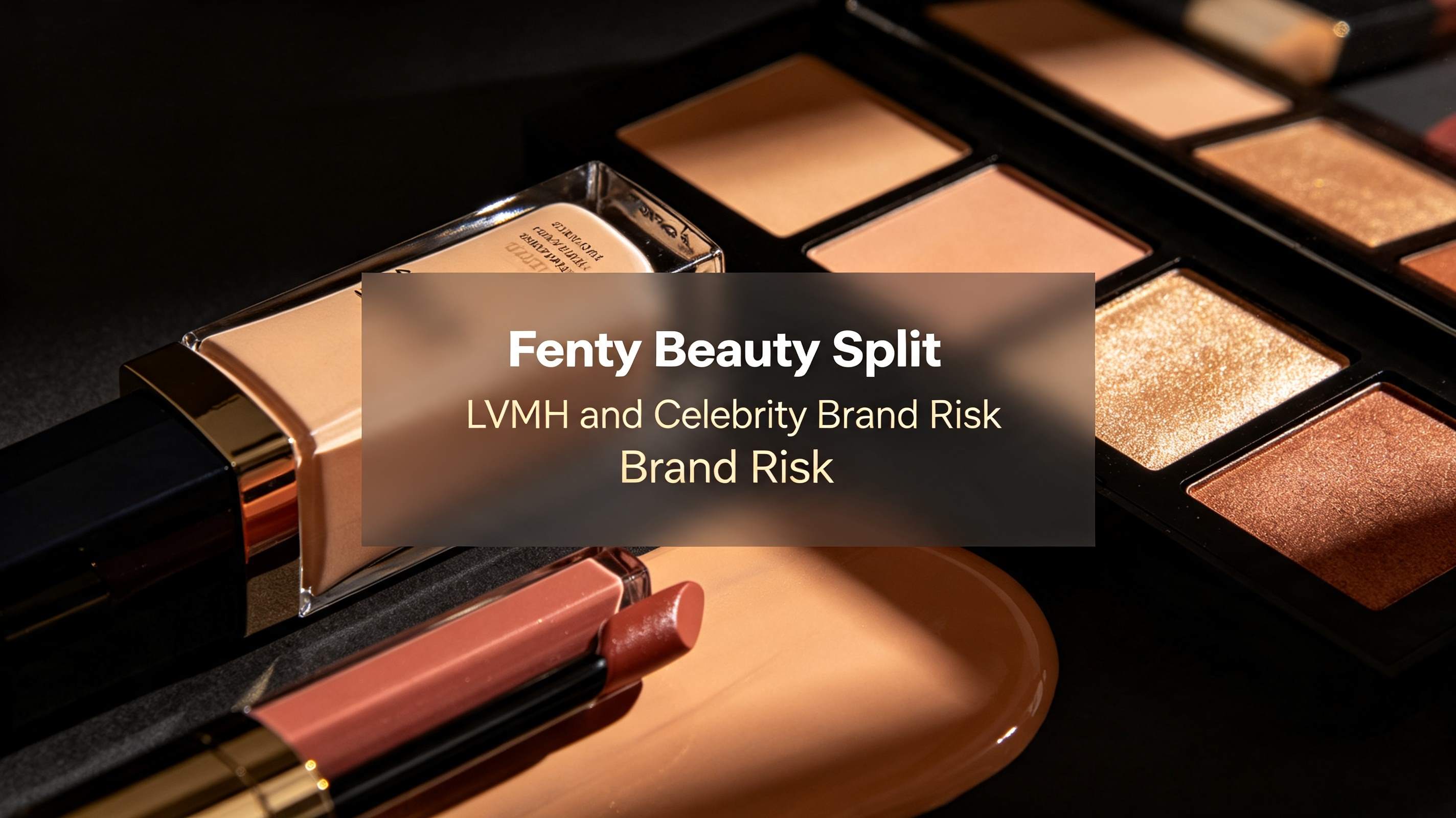
When LVMH and pop superstar Rihanna launched Fenty Beauty together in September 2017, almost no one in the beauty industry predicted that this celebrity brand would rewrite the industry’s diversity standards. Fenty Beauty launched with 40 foundation shades, spanning the full spectrum from the lightest to the deepest, instantly shattering the convention by which most brands focused on mid-range tones and ignored consumers with deeper skin. This inclusivity was more than a marketing slogan; it rapidly became the new industry baseline, forcing countless competitors to scramble and expand their own shade ranges. In its launch month, Fenty Beauty generated staggering sales, quickly becoming the success template for celebrity beauty brands.
Seven years later, the story has taken an unexpected turn. According to Reuters, LVMH is considering selling its entire 50 percent stake in Fenty Beauty and has hired the investment bank Evercore to manage the process. The transaction remains confidential, and neither LVMH nor Evercore has commented. Why has a brand once regarded as an important piece of LVMH’s beauty map reached the brink of a breakup? The answer reflects the lifecycle challenge of celebrity beauty brands and a luxury giant’s reassessment of its portfolio during a strategic adjustment. Understanding the deeper logic of this breakup requires placing Fenty Beauty back within LVMH’s overall beauty strategy and financial picture.
Financials: $450 Million in Sales and a $1 to $2 Billion Valuation Fenty Beauty sits within Kendo, LVMH’s beauty incubator, and is owned 50- 50 by LVMH and Rihanna. The brand is headquartered at 425 Market Street in San Francisco, and its CEO is Robyn Rihanna Fenty herself. In 2024, Fenty Beauty’s net sales were approximately $450 million, with the brand’s overall valuation ranging between $1 billion and $2 billion. That wide range reflects divergent market judgments about the sustainability of celebrity beauty brands: optimists see a brand that has validated its business model and possesses a powerful founder IP, while pessimists worry about the growth cliff once star power fades. The doubling gap between $1 billion and $2 billion is essentially a pricing disagreement over the question of how long Rihanna’s personal halo can endure.
Placing Fenty Beauty back within LVMH’s full picture clarifies the financial logic of the breakup. According to LVMH’s 2024 interim report, the group’s first-half revenue was 41.7 billion euros, down 1 percent (organic growth of 2 percent), with net profit down 14 percent to 7.267 billion euros. Under pressure on overall performance, LVMH’s scrutiny of asset profitability and strategic synergy inevitably sharpens. Notably, the perfume and cosmetics division grew 6 percent, and the Japanese market surged 44 percent. In other words, LVMH’s beauty portfolio as a whole is still growing, but Fenty Beauty’s $450 million in net sales, against a group generating tens of billions of euros, may no longer offer enough contribution or growth elasticity to justify continued investment of management resources. When a brand’s share of group revenue is negligible but the management attention and resources required to maintain a 50 percent stake are disproportionately high, letting go becomes a rational capital-allocation decision.
Even more telling is that this is the fifth brand divestiture or spin-off LVMH has considered within ten months. The density of these moves signals that this is not a one-off decision about Fenty Beauty but a systematic portfolio optimization across the luxury downturn. When high-end consumption slows and the group must concentrate resources to defend the core luxury houses, assets whose growth has peaked or whose synergy is limited get reassessed. Fenty Beauty, though a successful brand, may no longer compete effectively against core fashion and leather goods brands like Louis Vuitton and Dior for finite group resources in LVMH’s strategic priority stack. The involvement of Evercore suggests LVMH wants to maximize equity value through a professionalized process rather than a hasty disposal.
Inclusive Beauty: From Differentiation to Industry Standard
Fenty Beauty’s greatest historical contribution is that it redefined the diversity standard of the beauty industry. Before Fenty Beauty, most brands offered between 10 and 20 foundation shades, clearly skewed toward lighter tones, leaving consumers with deeper skin struggling to find a match. Fenty Beauty’s 40-shade launch turned inclusivity from an overlooked niche need into the industry’s passing grade. Since then, from Maybelline to Estee Lauder, from MAC to Rare Beauty, virtually every major brand has massively expanded its shade range. A single product decision by Fenty Beauty drove a standard upgrade across the entire industry.
But this industry standardization is a double-edged sword for Fenty Beauty. When inclusivity is no longer its exclusive differentiator, when every competitor can offer 40 or even 50 shades, the brand’s moat is invisibly eroded. A celebrity founder IP is a powerful asset, but beauty consumers are notoriously fickle; the next celebrity brand or viral product can redirect attention and wallets at any moment. This is the hurdle celebrity beauty brands find hardest to clear in their lifecycle: how to transition from the founder’s halo to the brand’s own equity. Fenty Beauty’s pace of product innovation, its execution in new-category expansion, and its operational synergy with Rihanna’s music and fashion career will all determine whether it can complete this transition.
LVMH’s choice to consider exiting now likely reflects this judgment. Selling when the brand has validated its business model and sits at a relatively high valuation is a rational financial decision for the group. For Rihanna, a buyback at a reasonable valuation or the introduction of a new strategic investor could give Fenty Beauty greater operational independence and strategic flexibility. Whether or not a deal ultimately closes, the Fenty Beauty case will become an important sample for studying the relationship between celebrity brands and luxury conglomerates.
ShopFindBiz Perspective
Analyzing Fenty Beauty’s storefront through ShopFindBiz captures key signals of a celebrity beauty brand’s lifecycle. First, the breadth of the shade range is a core competitiveness metric; by pulling SKU counts and shade distributions across foundation and concealer categories, you can quantify whether the inclusivity promise is being delivered at the product level, and if the shade matrix stops expanding or even contracts, the brand’s investment in differentiation is weakening. Second, new-release frequency reflects the brand’s ability to sustain buzz; celebrity brands depend heavily on launch volume to combat attention decay, and a slowing cadence is often a leading indicator of peaking growth. Tracking release-frequency trends through ShopFindBiz provides early warning of waning momentum. Third, the trajectory of social engagement data is vital for judging the decay curve of the celebrity IP; if content tied to the founder consistently outperforms product content, the brand remains dependent on personal star power rather than independent brand equity. Tracking these indicators through ShopFindBiz can flag whether a celebrity beauty brand is approaching its inflection point. Comparing Fenty Beauty with other brands in LVMH’s beauty portfolio also reveals how the group allocates resources and makes strategic trade-offs across the category.
Final Thoughts
Fenty Beauty used 40 foundation shades to change the rules of the beauty industry and used $450 million in annual net sales to prove the commercial potential of celebrity brands. But LVMH’s desire to break up is a reminder that celebrity halo and inclusivity narrative, while powerful launch accelerators, may not be a deep enough long-term moat. When a differentiator becomes the industry’s passing grade, where is the brand’s next growth narrative? That question belongs not only to Fenty Beauty but to every beauty brand banking on celebrity IP and a single concept. For practitioners in the beauty space, Fenty Beauty’s story is both a success manual on how to break industry conventions and an unsolved puzzle on how to cross the brand lifecycle. And LVMH’s breakup consideration offers a sobering reminder from the capital-market perspective: however dazzling the halo, it must ultimately return to growth elasticity and strategic synergy to pass the test.