Introduction
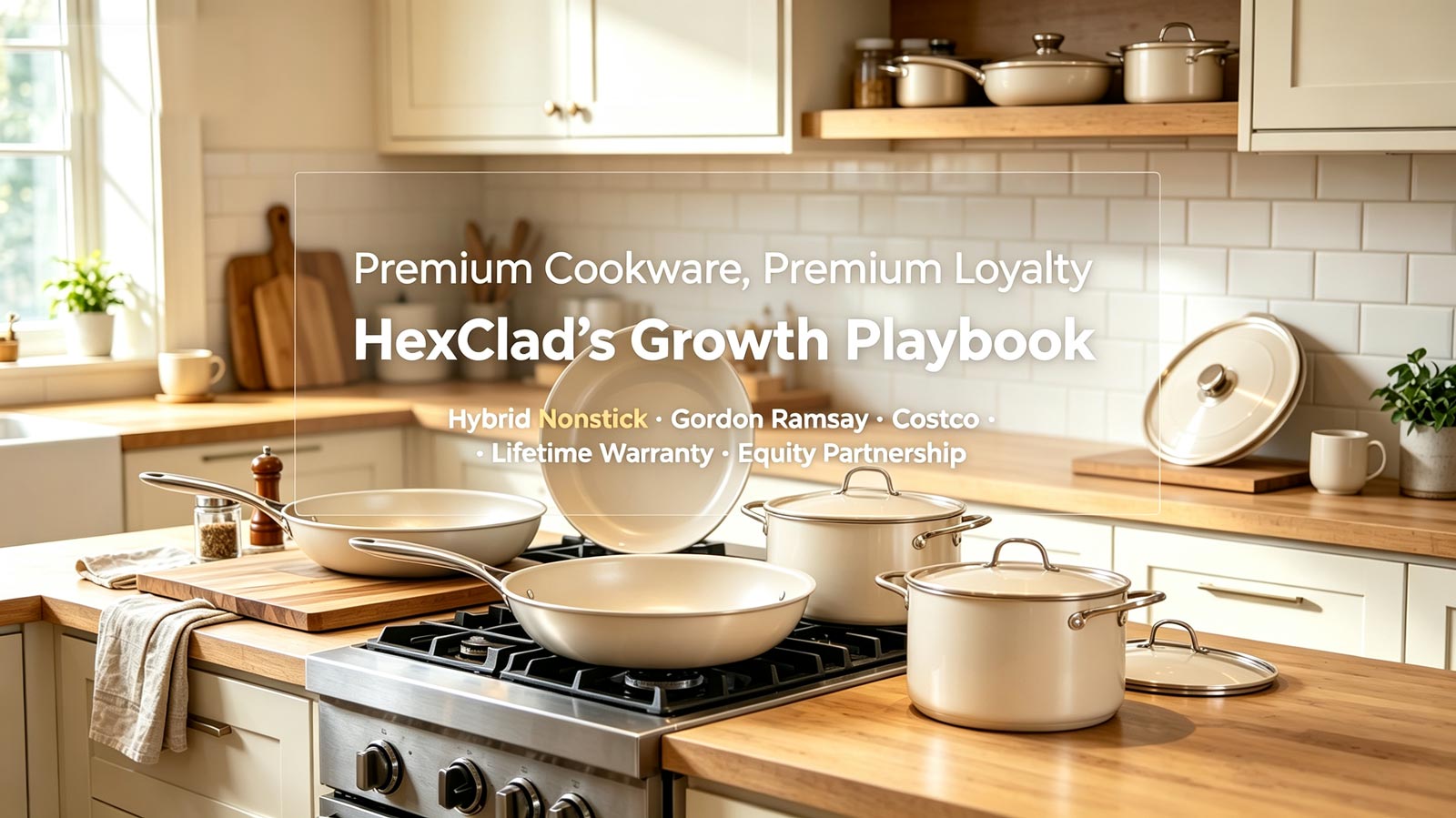
In 2016, two entrepreneurs with a failed juicer company behind them walked the floor of a trade show in Guangzhou, China. Daniel Winer, who had spent years as a national sales manager at a cookware brand, noticed something unusual: laser‑etched plates from a Korean barbecue supplier whose raised hexagonal pattern kept food from sticking without a fragile coating. That observation became HexClad — a cookware brand that hit a reported $1 billion valuation by mid‑2023, with revenue climbing from $170 million in 2022 to $380 million in 2023 and roughly $600 million expected in 2024.
The single biggest driver of that trajectory was a bet on one man: Gordon Ramsay. This analysis breaks down how Ramsay's backing, hybrid nonstick technology, and premium pricing turned skeptical buyers into loyalists — and what Shopify sellers can learn about using credibility to justify high price points.
From Failed Juicer to Costco Demo Tables
Winer and co‑founder Cole Mecray didn’t start as engineers or celebrity chefs. After their juicer venture collapsed, they applied the lessons to cookware: find a real product gap, prove demand in person, and only then scale. HexClad’s first distribution channel wasn’t Instagram or Amazon — it was Costco. In‑store demonstrations let shoppers see the hybrid surface in action before committing, and the wholesale deal validated that the product could sell at full price.
For direct‑to‑consumer sellers, this sequence matters: HexClad validated demand offline before pouring money into online acquisition. The brand officially launched in 2017, but the years spent refining the product at demo tables laid the foundation for everything that followed.
The Ramsay Bet: Endorsement as Equity, Not Advertising
Celebrity partnerships usually look like paid posts. HexClad’s didn’t. Ramsay reportedly noticed the design around 2020 and started using the pans himself. By 2021 he wasn’t just the face of the brand — he was an investor and equity partner, meaning his fortune rose or fell with the product’s quality. In July 2024, his Studio Ramsay Global made a $100 million investment in the company.
That structure changed the economics of endorsement in three ways:
- Authenticity: Ramsay cooked with HexClad in his own kitchens and on camera — the pans weren’t a prop, they were his tools. When he called them “the Rolls Royce of pans,” the claim carried weight because his name was literally on the cap table.
- Alignment: HexClad’s target buyer — serious home cooks willing to spend $99 to $998 on a single pan — overlapped almost perfectly with Ramsay’s audience. The endorsement filtered out bargain hunters and pre‑qualified premium buyers.
- Escalating reach: The partnership peaked in February 2025, when HexClad ran its first‑ever Super Bowl ad — a playful Area 51 spot — a stage normally reserved for century‑old brands, not nine‑year‑old ones.
Hybrid Nonstick: A Product That Earned the Price Tag
Endorsement gets attention; product keeps customers. HexClad’s core innovation is a laser‑etched hexagonal pattern that combines stainless steel’s durability with nonstick convenience. Food lifts off the steel peaks while the valleys hold a thin oil film, so pans sear like stainless but clean like nonstick. The design also works on induction and resists scratching and warping — solving the three biggest complaints about both traditional nonstick (short lifespan) and stainless (food sticking).
The company backs the engineering with a lifetime warranty, which quietly reframes a $300 pan from an expensive purchase into a one‑time investment. That value proposition — cost‑per‑use instead of sticker price — is what converts comparison shoppers at the premium tier.
Premium Pricing as a Positioning Tool
HexClad never discounted its way into relevance. By holding price points between $99 and $998, the brand achieved three things at once: it funded the celebrity partnership, it signaled quality through price itself, and it created aspirational demand among buyers who treat cookware like equipment rather than a household commodity. In a category dominated by $30 pans and $300 heritage sets, HexClad carved out a middle‑luxury tier with almost no direct competition.
Lessons for Shopify Sellers
- Start with a product gap, not a marketing plan. HexClad’s founders found the hexagonal pattern first and the celebrity second. A defensible product gives every later investment something to compound.
- Structure partnerships as alignment, not transactions. Few sellers can match a $100 million equity deal, but the principle scales down: negotiate revenue‑share or affiliate deals with mid‑tier creators in your niche instead of one‑off sponsored posts. When a creator profits from your product’s success, their advocacy becomes genuine.
- Validate demand before scaling spend. Costco demos were HexClad’s version of a small‑budget ad test — prove conversion first, then amplify.
- Sell cost‑per‑use, not price. Lifetime warranties, durability proof, and comparison content help buyers justify premium price points to themselves.
- Price for the customer you want. Discounting attracts deal‑seekers who churn; premium pricing attracts loyalists who evangelize.
Conclusion
HexClad’s journey from a trade‑show observation to a Super Bowl ad in under a decade comes down to three stacked advantages: a genuinely differentiated product, a celebrity partnership structured around equity rather than fees, and premium pricing that funded the flywheel. The $1 billion valuation wasn’t the result of one lucky bet — it was a sequence of bets, each one validating the next. For e‑commerce sellers, the playbook is clear: build something worth endorsing, find partners whose incentives match yours, and let confidence in the product — not discounts — close the sale.