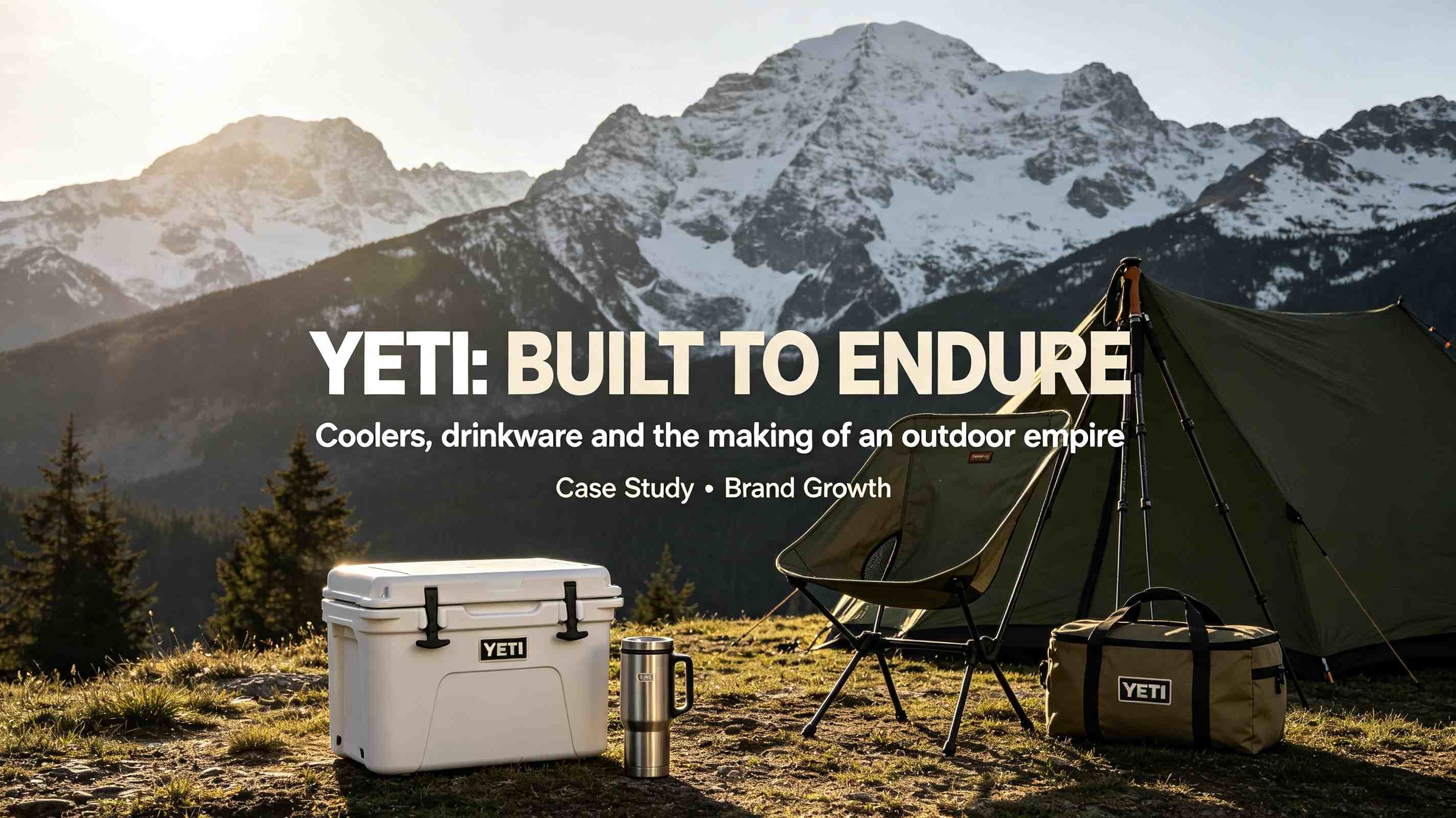
Introduction
In 2006, in Austin, Texas, brothers Roy and Ryan Seiders founded YETI out of a frustration shared by serious fishermen and hunters: the coolers on the market were either too flimsy or simply could not hold ice long enough for extended trips into the wilderness. Their answer was to build a cooler that was virtually indestructible and capable of extraordinary ice retention. Priced well above the average competitor, it nonetheless earned fierce loyalty among professional outdoorsmen. Few could have predicted that this fishing- boat cooler would, over nearly two decades, grow into a company generating $1.83 billion in annual revenue.
YETI’s story matters because it navigated three notoriously difficult balancing acts at once: extending a niche professional tool into a mass lifestyle brand, expanding from a single hero product into a multi-category portfolio, and sustaining a premium pricing strategy while scaling distribution. And now that Stanley has overtaken YETI to claim the top spot in the U.S. drinkware market, the question of how YETI defends its moat has become far more urgent. YETI is known for high durability and premium positioning, which is an advantage in a consumption upgrade cycle but exposes vulnerabilities when social- media-driven trends and downtrading pressures emerge. The answers lie in a close dissection of its financials, category structure, and channel strategy.
Financial Performance: The Logic Behind $1.83 Billion
According to YETI Holdings’ 2024 annual report filed with the SEC, the fiscal year ending December 28, 2024 produced total net sales of $1.83 billion, with net income of $176 million and basic earnings per share of $2.07. In the first quarter of 2024 alone, revenue reached $341 million, up 12.8 percent year over year, with U.S. revenue at $275.8 million, confirming that the home market remains YETI’s bedrock. As of early 2025, the company’s market capitalization stood at roughly $3.669 billion, with a trailing price-to-earnings ratio of about 24.56, a reasonable but not cheap valuation that reflects market recognition of steady growth alongside caution about whether YETI can return to a high-growth trajectory.
It is worth noting that YETI’s products are primarily manufactured in China, covering both plastic and stainless steel lines, which means tariff policy and supply-chain cost fluctuations have a direct bearing on gross margin. Under sustained U.S.-China trade tensions, this manufacturing footprint is both a source of cost advantage and a concentrated risk point. Any tariff increase could directly compress YETI’s gross margin, while shifting production to other regions would mean enormous reinvestment and quality-control risk. Despite this exposure, YETI has held firm on premium positioning. A Tundra hard cooler can cost several hundred dollars, and a Rambler tumbler is priced well above comparable items. The strategy works because YETI has consistently anchored its consumer perception around extreme durability and professional-grade quality. When customers believe they are buying a product that will last a lifetime, price sensitivity drops dramatically.
The growth structure reveals that YETI no longer depends solely on coolers. Drinkware, encompassing insulated tumblers and water bottles, has become the company’s fastest-growing category, outpacing the legacy cooler business. The significance of this shift is enormous: a tumbler is used across far more occasions than a cooler, extending from the fishing boat to the office, the gym, the school run, and the morning commute. Every new usage occasion multiplies the potential customer base, and that is precisely the lever that has carried YETI from a niche hunting-and-fishing audience into the broader outdoor lifestyle mainstream. Coolers define the brand soul of indestructible YETI, while drinkware carries that soul toward a far larger market. The synergy is that coolers set the premium ceiling for the entire brand, and drinkware breaks through on volume beneath that ceiling.
Categories and Channels: The Balancing Act
YETI’s current product portfolio spans four pillars: coolers, drinkware, bags, and other outdoor gear. Coolers are the foundation, defining the brand promise that YETI equals indestructible. Drinkware is the growth engine, pulling the brand toward a mass audience. Bags and accessories extend the usage occasions and lift average order value and repeat purchase rates. This structure, in which a heritage category protects the brand soul, a growth category opens the market, and extension categories raise customer lifetime value, is the essence of YETI’s category strategy. For cross-border brands, the lesson is not to rush into expansion before the founding category has built sufficient mindshare, but to let the heritage category fully establish the brand tone before using a growth category to capture broader demand.
On the channel side, YETI runs a dual model combining direct-to-consumer with wholesale. The DTC channel lets YETI control first-party consumer data, brand storytelling, and pricing while delivering higher gross margins. The wholesale channel leverages retail partners’ store networks to penetrate the market quickly and lower customer acquisition cost. Balancing the two is delicate. Over-reliance on DTC exposes the brand to rising traffic costs, while over-reliance on wholesale risks diluting premium positioning. YETI has maintained a relatively stable ratio between the two, an institutional reason it has kept growing even as many DTC peers have struggled. The DTC channel also gives YETI the ability to run limited colorway drops and member-exclusive product tests, brand-tactics difficult to execute in wholesale, that are essential to maintaining consumer freshness and brand heat.
Yet the competitive pressure is intensifying. In 2024, Stanley, riding the viral success of its Quencher tumbler across social media, overtook YETI to become the leading drinkware brand in the United States, pushing YETI into second place. Stanley’s ascent proves the power of an aesthetic single product paired with social propagation in this category, posing a direct threat to YETI’s hardcore professional image. Stanley captured two forces: female consumers and social-media virality, while YETI’s customer profile still skews male and professional-outdoor. This demographic gap means YETI’s growth ceiling in drinkware may be constrained by Stanley’s first-mover advantage among women and younger shoppers. Whether YETI can win over those audiences without abandoning its rugged identity will determine the trajectory of its drinkware business. This tumbler war is fundamentally not a contest of product capability but a battle for brand narrative and consumer mindshare.
ShopFindBiz Perspective
Analyzing YETI’s storefront through ShopFindBiz surfaces several key signals. First, YETI’s SKU structure follows a classic pyramid: high-ticket coolers at the top to anchor the professional, premium brand perception; a wide range of drinkware in the middle as the volume driver for acquisition and repeat purchase; and bags and accessories at the base to raise attach rates and average order value. Second, on pricing, YETI barely discounts on its own site, consistent with its premium positioning; rather than cutting prices, it creates purchase urgency through limited colorways and seasonal drops. Third, the discipline of price consistency between wholesale and DTC channels is verifiable through ShopFindBiz, and YETI controls this tightly. By pulling YETI’s product analysis and social data through ShopFindBiz, you can quickly assess its competitive posture against Stanley in drinkware and identify which colorways and sizes are generating the most social engagement, providing data-backed guidance for your own category and pricing strategy.
Final Thoughts
Starting from a single cooler, YETI spent nearly two decades building a $1.83 billion outdoor lifestyle empire. Its success confirms that the path of using extreme product quality and a clear brand narrative to open up premium pricing space in an ostensibly traditional category remains valid. But Stanley’s overtaking is a reminder that when a new propagation paradigm emerges, an incumbent’s mental moat is not unbreakable. YETI’s future growth hinges on whether it can find a product language in drinkware that stays true to its identity while resonating with a broader audience, and whether it can build enough buffer between its China supply-chain dependence and tariff risk. For practitioners in cross-border commerce and the outdoor space, YETI’s category structure and channel balance offer a template worth studying closely, and its response to Stanley’s challenge will be a key sample for observing how outdoor brand competition evolves.